On this page+
The 7-speed DQ200 DSG has two clutches, but only one clutch housing. Both clutches work dry, without oil, and both are operated by the mechatronic unit. How these two clutches share the work explains why the DSG shifts so quickly — and why clutch faults and mechatronic faults often look alike.
Two gearboxes, two clutches
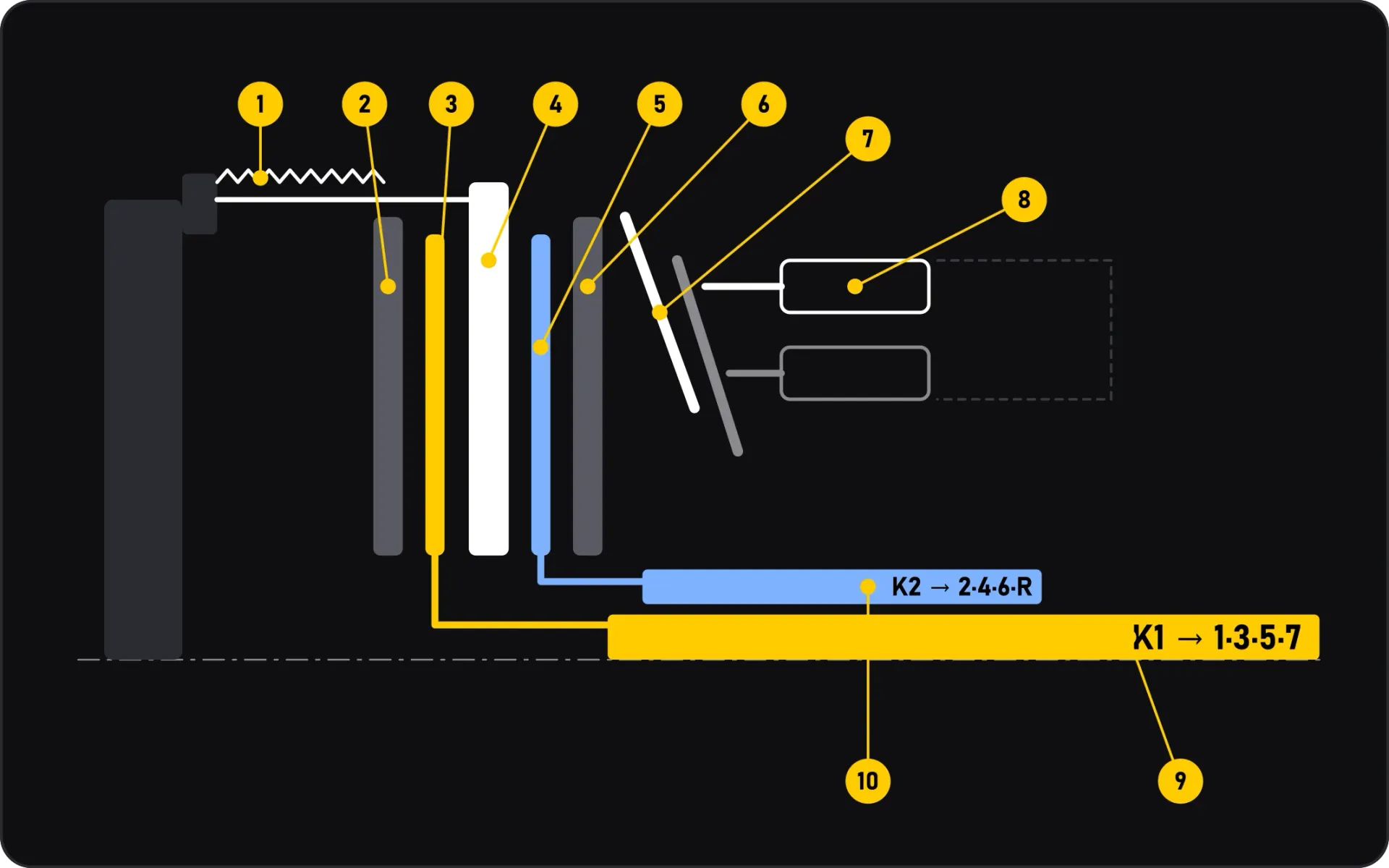
Mechanically, the DQ200 is two gearboxes in one housing. Clutch K1 drives input shaft 1 and with it the odd gears 1, 3, 5 and 7. Clutch K2 drives input shaft 2 and with it the even gears 2, 4 and 6 and reverse. Input shaft 1 runs inside the hollow input shaft 2.
While you drive in one gear, the next gear is already engaged on the other shaft. A shift is simply a change of clutch: one clutch opens while the other closes. Apart from this brief overlap, only one clutch transmits the engine torque at a time.
What is inside the dual clutch
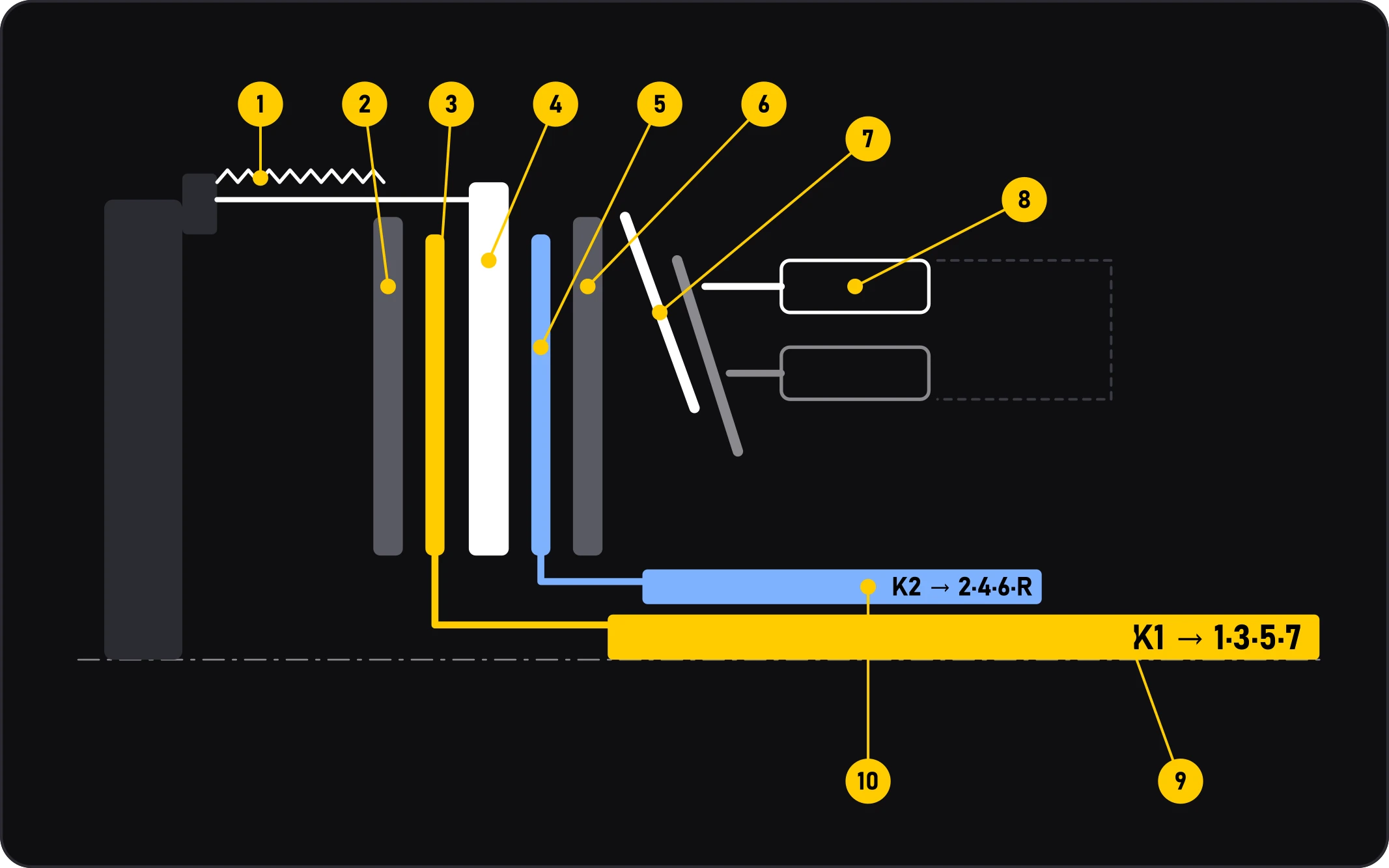
- Outer teeth: the engine torque enters the dual clutch here, from the dual-mass flywheel.
- Pressure plate 1 clamps clutch disc K1.
- Clutch disc K1 is connected to input shaft 1.
- Drive plate: the central plate that turns with the engine; both clutch discs are pressed against it.
- Clutch disc K2 is connected to input shaft 2.
- Pressure plate 2 clamps clutch disc K2.
- Engagement levers: one lever for each clutch, pushed by the mechatronic.
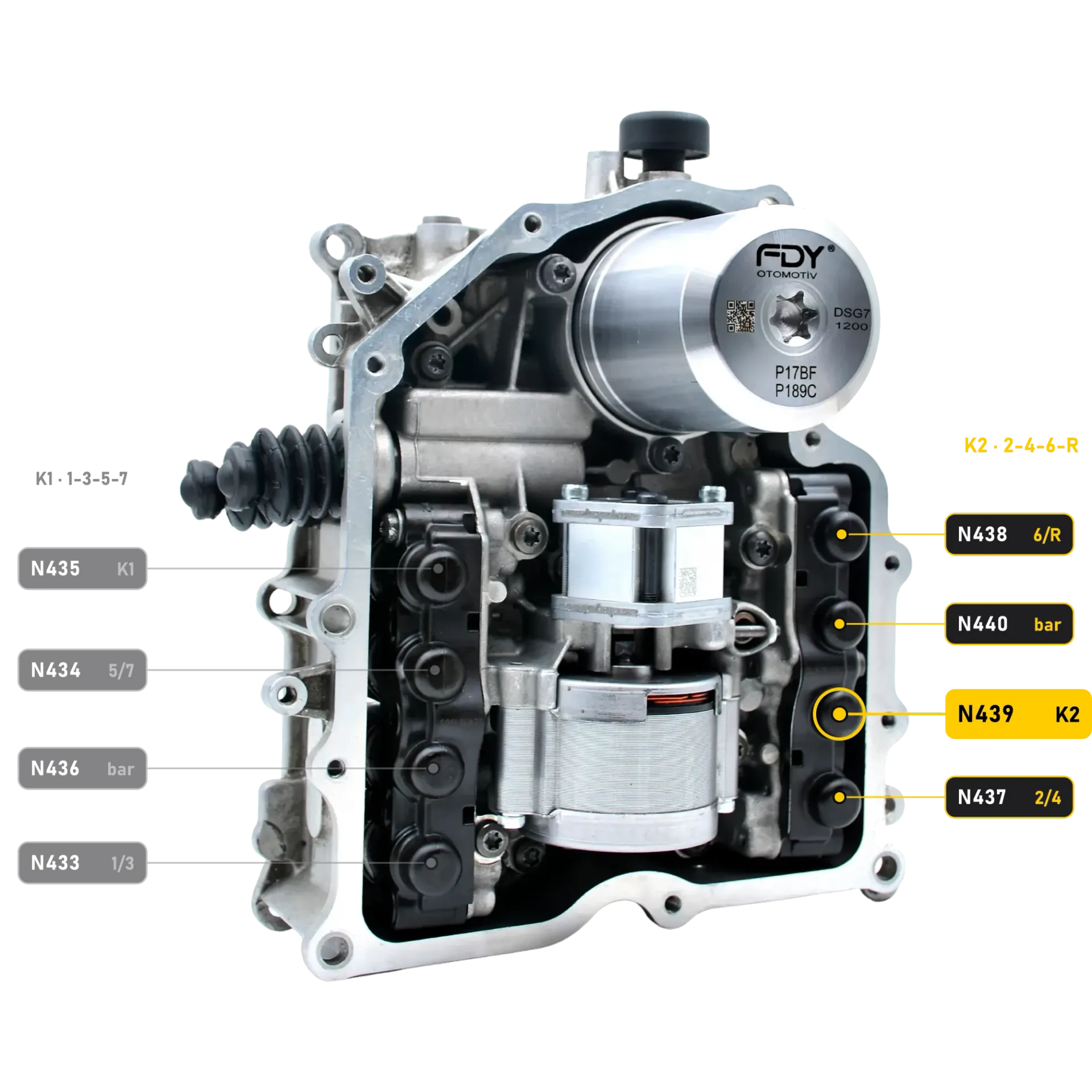
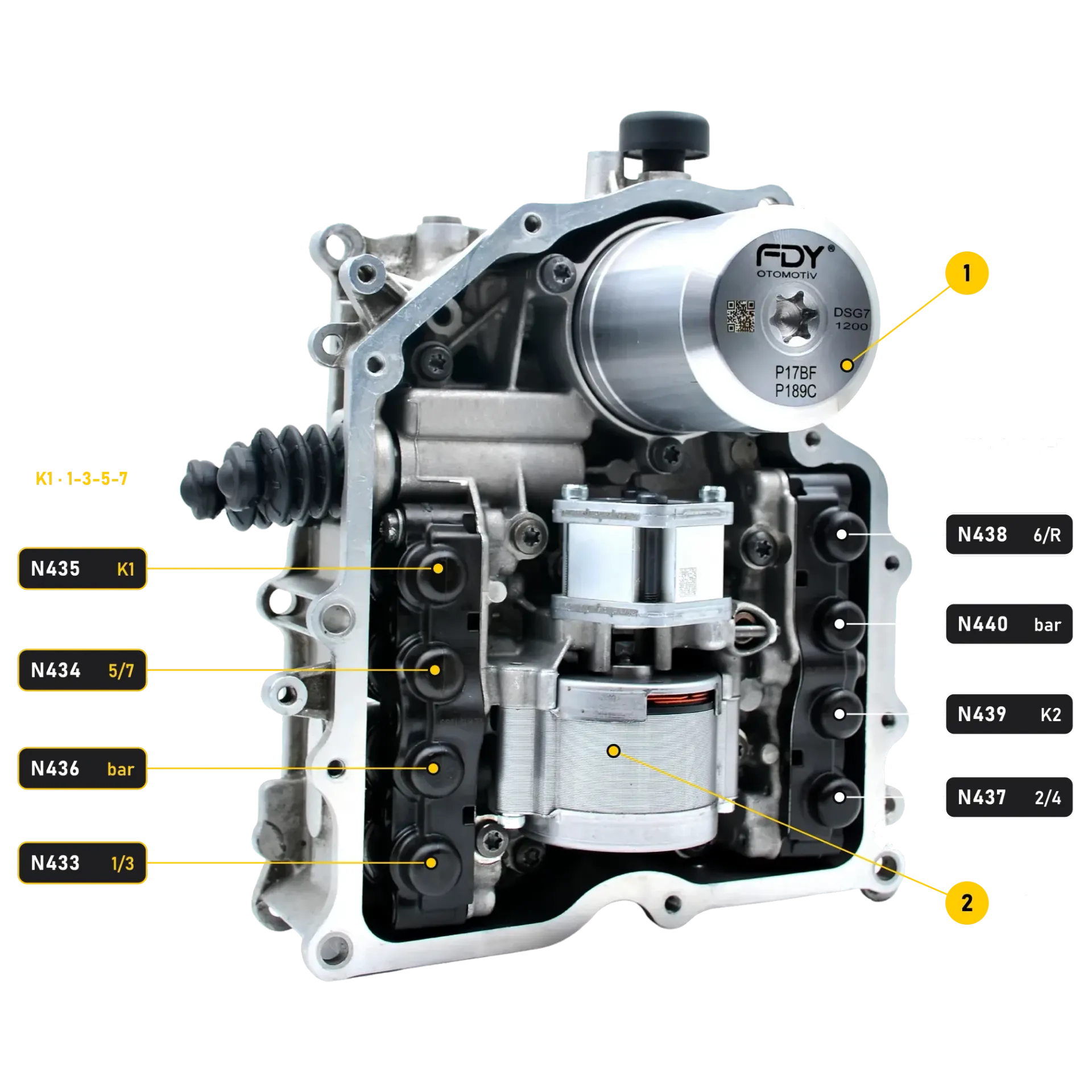
- Clutch actuators: two hydraulic cylinders in the mechatronic, one for K1 and one for K2.
- Input shaft 1 — gears 1, 3, 5 and 7.
- Input shaft 2 — gears 2, 4, 6 and reverse.
Both clutches are open when they are not operated. If no clutch is actuated, no torque reaches the gearbox. To close a clutch, the mechatronic fills its actuator cylinder with oil; the piston rod pushes the engagement lever, the pressure plate moves and the clutch disc is clamped against the drive plate. A magnet on each actuator piston tells the clutch travel sensors (G617 for K1, G618 for K2) exactly how far the clutch has moved.
The clutch is controlled by position
Because the clutches are dry and open by default, the TCU controls them by position: it moves each actuator to a precise travel and watches the result through the travel and speed sensors. For that it has to know each clutch's kiss point — the position at which the clutch starts to transmit torque. The kiss point moves as the linings wear, so the TCU adapts it continuously while the car is driven. After a clutch or mechatronic replacement, it is learned from scratch during the basic setting.
This is also why a clutch problem and a valve problem can feel the same: if a clutch valve regulates unevenly, the clutch grabs, just as a worn clutch does. Our article on jerks into 2nd and 4th gear shows how to separate the two.
Two generations and adjustment shims
When a DQ200 clutch is fitted, its correct axial position is set with adjustment shims. The shims come in different thicknesses, and the right one is chosen by measuring, following the procedure in the manufacturer's repair information.
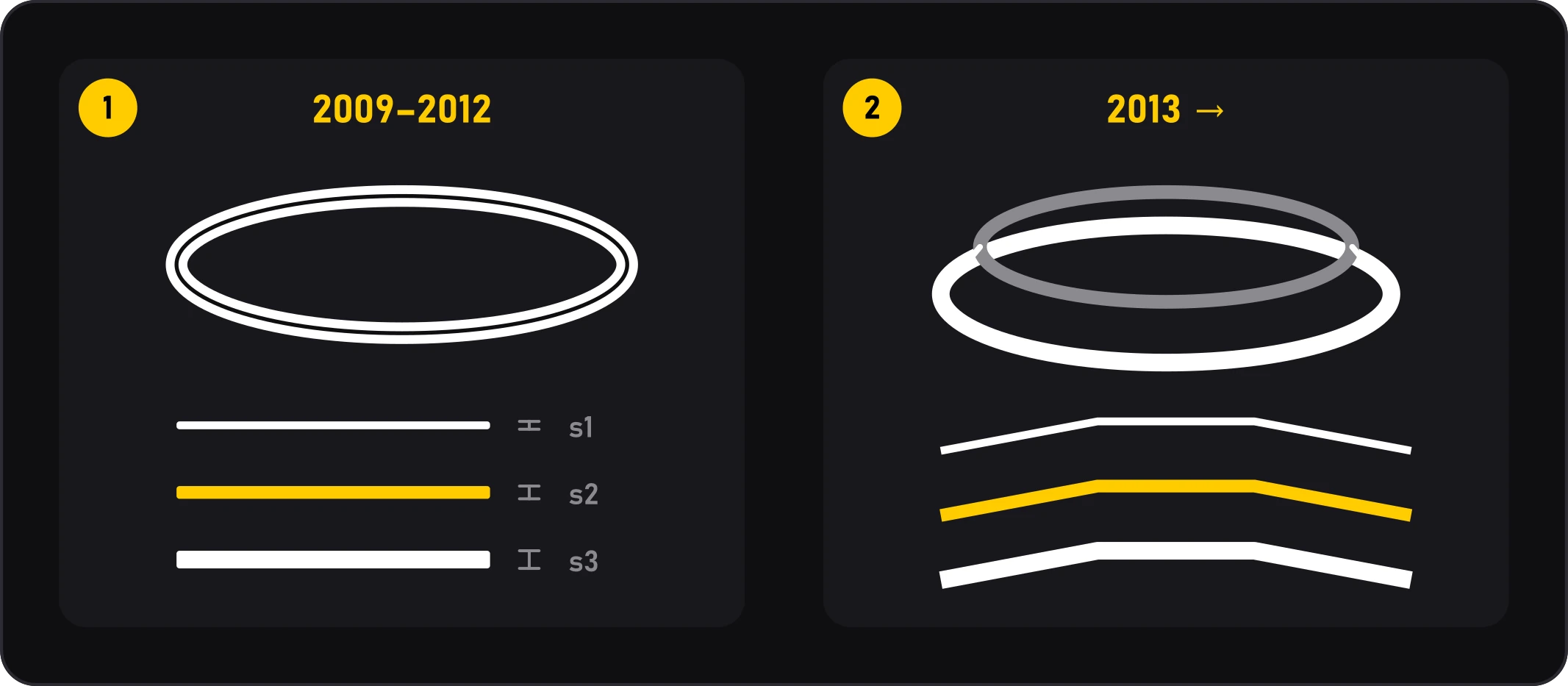
- First-generation clutches (roughly 2009–2012) use a flat shim.
- Second-generation clutches (roughly 2013 onwards) use a conical, dished shim.
Use the shim type that belongs to the clutch you are fitting, and do not reuse shims by guesswork. A clutch that sits in the wrong position may still drive, but the basic setting can fail and the shifts can be harsh or slip.
Signs of a worn or faulty clutch
- Judder when pulling away, especially uphill or in stop-and-go traffic.
- The engine speed rises without the car accelerating — the clutch slips.
- Harsh engagement or a clunk when pulling away or when shifting.
- The basic setting is aborted at the clutch kiss-point step.
- Clutch-related fault entries in the gearbox control unit.
Before replacing a clutch, rule out the mechatronic: a clutch valve that sticks, a clutch actuator that leaks or a sensor fault can produce the same symptoms. And check the gearbox for metal chips — our metal-chip check explains how.
When the clutch is replaced
- Use the special tools and follow the measuring procedure for the adjustment shims.
- Inspect the engagement levers and the clutch actuators of the mechatronic, and replace the parts the repair information specifies as single-use.
- Carry out the basic setting so that the new kiss points are learned.
- Finish with a calm road test through all gears and a final check of the fault memory.
If the mechatronic was removed during the job, test it on the bench before it goes back in: the FDY mechatronic test device checks the clutch valves, the pressure supply and the leak tightness, so a new clutch is not paired with a faulty mechatronic.
Frequently asked questions
01Is the DQ200 clutch wet or dry?+
Dry. Both clutches work without oil. The oil in the mechatronic is only used to operate the clutch actuators and the gear actuators.
02Which gears does clutch K1 drive and which does K2 drive?+
K1 drives input shaft 1 with gears 1, 3, 5 and 7. K2 drives input shaft 2 with gears 2, 4, 6 and reverse.
03Are the DQ200 clutches open or closed at rest?+
Open. When neither clutch is operated, no torque is transmitted. The mechatronic closes each clutch hydraulically when it is needed.
04Is a basic setting needed after a clutch replacement?+
Yes. The gearbox must learn the kiss points of the new clutch; without the basic setting it may engage harshly or not drive away.
05Why are there different adjustment shims?+
The shims set the correct position of the clutch. They come in different thicknesses, and first- and second-generation clutches use different shim designs.
Talk to a DQ200 specialist
Not sure whether the problem is the clutch or the mechatronic? Send us your fault codes and symptoms, and our engineers will help you decide. FDY supports workshops and distributors 24/7 — contact us.